Marketing
Growth Analyst
Your AI-powered marketing sidekick. Connects to PostHog to analyze traffic, referrers, conversions, and retention — then delivers weekly actionable growth recommendations.
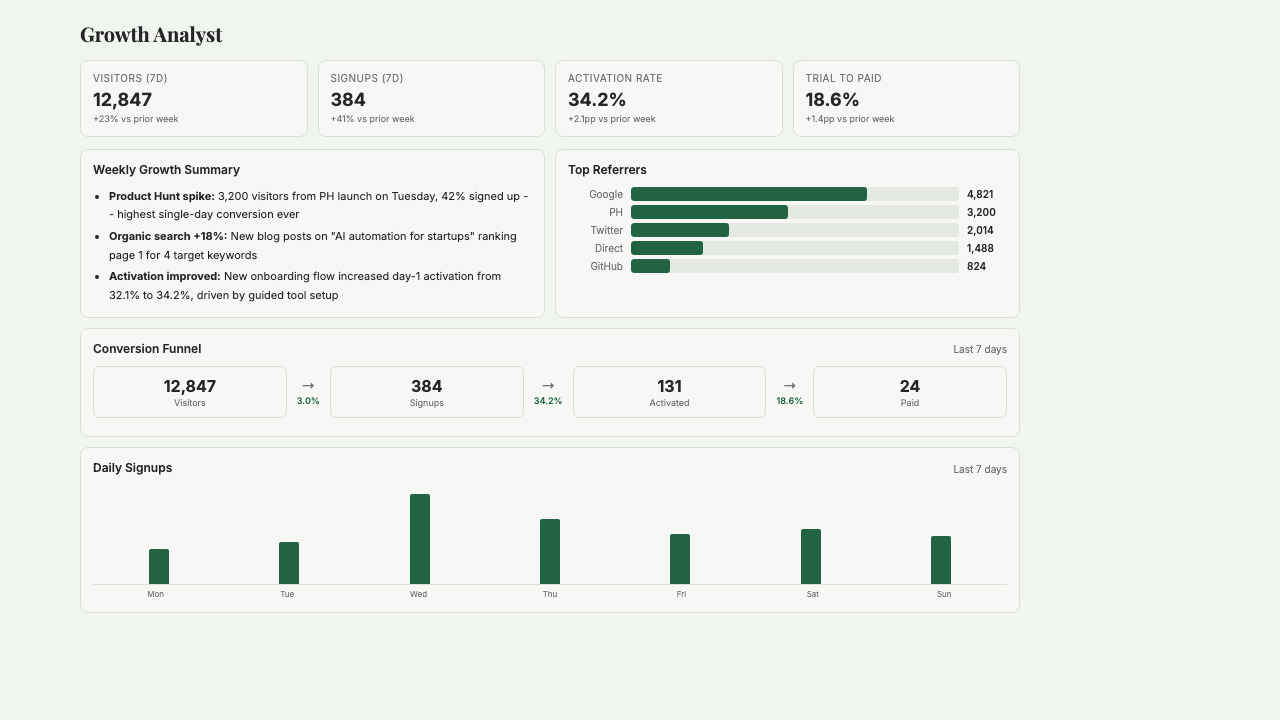
What is Growth Analyst?
Growth Analyst is an AI marketing sidekick that connects to PostHog, reads your traffic and conversion data, and emails you a weekly digest summarizing what changed, what's working, and where to focus next. It's not another dashboard you forget to check — it's an analyst that tells you the three things that actually matter this week, with the numbers that back them up. Each digest covers signup trends, top referrers, conversion rate changes by channel, and content that's driving the most activity, along with specific suggestions for what to try next. Built for operator founders who know they should be more data-driven but don't have time to build the analytics muscle from scratch or hire a growth marketer.
Key Features
Who it's for
- Operator founders who promised themselves they'd look at the numbers every week and never do
- Small teams already using PostHog but not getting enough value from it
- Founders who've tried Google Analytics and bounced off — too much data, not enough insight
- Two-person teams that want a growth marketer's perspective without hiring one
Example workflows
Set up your first weekly growth digest
- 1Connect your PostHog account via API key (one-step OAuth).
- 2Tell Growth Analyst which metrics matter to you: signups, trial starts, activation events, or whatever your funnel step is.
- 3Pick the day you want the digest delivered (most founders pick Monday morning).
- 4Growth Analyst waits for seven days of data, then emails your first digest with top insights and recommendations.
- 5Reply to the email with follow-up questions and Growth Analyst answers with specific numbers.
Diagnose a conversion drop
- 1Notice something feels off — signups are down, or a specific channel is underperforming.
- 2Ask Growth Analyst what changed in the last 7 days across your funnel.
- 3Review the breakdown: which step dropped, on which device, from which traffic source.
- 4Act on the suggested fix — change a CTA, test a different landing page, pause a bad ad — and Growth Analyst tracks the impact in next week's digest.
What you can ask
"Where are my best leads coming from?"
"Which marketing channel should I double down on?"
"What's my signup conversion rate this week?"
"Compare this week's traffic to last week"
"What content is driving the most signups?"
Frequently asked questions
Do I need to already have PostHog set up?
Yes. Growth Analyst reads from your existing PostHog instance. If you don't have PostHog yet, you can set it up in about 30 minutes — it's free for small sites and integrates with most frontend frameworks. Once PostHog is collecting traffic and event data, Growth Analyst can produce useful digests within a week.
How is this different from just reading PostHog dashboards?
PostHog dashboards show you data. Growth Analyst interprets it: it tells you what changed week over week, which changes matter, and what to do about them. The value isn't the numbers — it's the prioritization. Most founders don't look at dashboards because they don't know which numbers matter. Growth Analyst decides for you.
What does 'actionable recommendations' actually mean?
Concrete, specific suggestions tied to what it sees in your data. Examples: 'Traffic from Product Hunt is converting 3x better than Twitter — double down on PH-style content this week,' or 'Signup conversion on your pricing page dropped 22% after Tuesday — check if the new CTA is working on mobile.' Specific actions you can take today, not abstract advice.
Can it see mobile app data or only websites?
PostHog supports both web and mobile apps, and Growth Analyst reads whatever PostHog is tracking. If your PostHog instance collects both, your digest will cover both. If it's web-only, the digest will be web-only.
Does it replace a growth marketer?
For early-stage founders doing their own marketing, yes — it covers the analyst work a part-time growth marketer would do: weekly reporting, channel attribution, and prioritization. It doesn't replace strategic work like brand positioning, creative development, or campaign execution. Think of it as the first 20 hours a week a growth hire would spend — automated.
How quickly does the digest get useful?
You'll get a baseline digest after the first week once Growth Analyst has seven days of comparison data. It gets significantly more useful by week 3–4, when it has enough history to identify real trends (not one-week noise) and calibrate to your specific traffic patterns.
Get started with Growth Analyst
Join founders already using Starch to run their business smarter.
You're on the list! We'll be in touch soon.